
If you have ever studied basic chemistry or prepared for a competitive exam, you have almost certainly come across this question: which metal is found in liquid state at room temperature? The answer is Mercury (Hg), and it is one of the most fascinating exceptions in the periodic table. While nearly all metals are solid under normal conditions, mercury remains in liquid form, and this unusual property has made it a favorite topic for students, teachers, and quiz enthusiasts alike.
In this article, we will explore why mercury behaves this way, its key properties, its practical applications, safety concerns, and — importantly — where and how this question is commonly asked in exams.
Read Also Which One of the Following Is a chemical change?
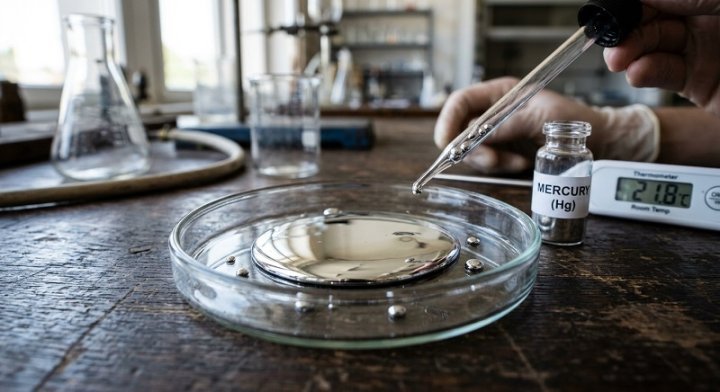
The Answer: Mercury (Hg)
Mercury is a heavy, silvery-white metal with the chemical symbol Hg, derived from its Latin name “hydrargyrum,” meaning “liquid silver.” It has an atomic number of 80 and is the only metal that exists in a liquid state at standard room temperature (around 25°C or 77°F) and pressure.
Mercury’s melting point is -38.83°C, which is far below room temperature, meaning it stays liquid unless cooled significantly. Its boiling point is 356.7°C, giving it a wide liquid range compared to most substances.
Why Is Mercury Liquid at Room Temperature?
This is where the chemistry gets interesting. Most metals form strong metallic bonds because their outer electrons are loosely held and move freely between atoms, creating a rigid lattice structure. Mercury, however, has a unique electron configuration.
Because of a phenomenon called the relativistic effect, mercury’s electrons — particularly the 6s electrons — move at speeds close to the speed of light due to the high positive charge of its nucleus. This causes the electrons to be pulled closer to the nucleus and become less available for metallic bonding. As a result, the atoms in mercury are held together by weak van der Waals forces rather than strong metallic bonds, allowing the metal to flow like a liquid instead of forming a solid structure.
Simply put: mercury’s electrons behave differently because of relativity-driven effects, weakening the bonds between its atoms.
Key Properties of Mercury
- State at room temperature: Liquid
- Color: Silvery-white, shiny
- Density: Very high (13.6 g/cm³) — much denser than water
- Conductivity: Good conductor of electricity
- Surface tension: High, causing it to form small round droplets
- Toxicity: Highly toxic in vapor and certain compound forms
Common Uses of Mercury
Despite growing restrictions due to toxicity, mercury has historically been used in several important applications:
- Thermometers and barometers – due to its uniform thermal expansion.
- Fluorescent lamps and CFL bulbs – mercury vapor helps produce light.
- Dental amalgams – used in older tooth filling materials.
- Industrial processes – such as gold and silver extraction.
- Electrical switches and relays – because of its conductivity and liquid nature.
Note: Many countries are now phasing out mercury-based products due to environmental and health hazards, replacing them with safer alternatives like digital thermometers and LED lighting.
Is Mercury the Only Metal Close to Liquid State?
While mercury is the only metal liquid at standard room temperature, a few other metals come close and turn liquid slightly above room temperature:
- Gallium (Ga): Melts at just 29.76°C — it can literally melt in your hand.
- Cesium (Cs): Melts at 28.5°C, though it’s highly reactive with air and water.
- Francium (Fr): Theoretically has a low melting point but is extremely rare and radioactive.
- Rubidium (Rb): Melts at around 39°C.
These metals are often included in “trick” exam questions that test whether students confuse “low melting point” with “liquid at room temperature.”
Safety Precautions
Mercury is toxic, and exposure to its vapor can cause serious health issues, including neurological and kidney damage. It should always be handled with care, and broken mercury thermometers should never be touched directly. This is one reason global regulations, such as the Minamata Convention on Mercury, aim to reduce mercury use worldwide.
Where Is This Question Asked?
The question “which metal is found in liquid state at room temperature” is extremely popular across academic and competitive exam platforms. It is commonly asked in:
- School exams: Class 8–12 Chemistry/Science (CBSE, ICSE, State Boards)
- Competitive government exams: SSC CGL, SSC CHSL, SSC MTS
- Banking exams: IBPS PO/Clerk, SBI PO/Clerk, RBI Assistant (General Awareness section)
- Railway exams: RRB NTPC, RRB Group D, RRB ALP
- UPSC and State PSC exams: Prelims General Studies
- Defence exams: NDA, CDS, Police Constable exams
- Teaching eligibility exams: CTET, TET, and other B.Ed entrance tests
- General knowledge quizzes and Olympiads: School-level Science Olympiads, quiz competitions
Because it tests fundamental chemistry knowledge in a memorable way, this question is a favorite among exam setters for General Science and General Awareness sections.
How Many Types of This Question Can Be Asked?
Exam setters often rephrase the same core concept in different formats. Here are the most common variations you might encounter:
- Direct MCQ: “Which metal is liquid at room temperature?” (Options: Mercury, Iron, Gold, Silver)
- Fill in the blanks: “________ is the only metal that is liquid at room temperature.”
- One-word/short answer: “Name the metal that remains liquid at 25°C.”
- Assertion-Reason type: “Assertion: Mercury is liquid at room temperature. Reason: It has weak metallic bonding due to relativistic effects. Choose the correct option.”
- True/False statement: “Mercury is a non-metal that exists in liquid form. (True/False)”
- Match the following: Matching metals with their physical states or melting points.
- Odd one out/Exception-based: “Which of the following is an exception among metals in terms of physical state?”
- Reasoning-based questions: “Why is mercury liquid at room temperature while other metals are solid?”
- Application-based questions: “Which liquid metal is used in traditional thermometers?”
- Comparative questions: “Which metal has the lowest melting point among the given options?” (testing gallium vs. mercury confusion)
Understanding these variations helps students prepare more effectively, since exams rarely repeat questions in the exact same wording.
Conclusion
Mercury stands out as the only metal that is liquid at room temperature, a property rooted in its unique atomic structure and relativistic electron behavior. Beyond being a fascinating chemistry fact, this topic is a recurring favorite in school exams, competitive exams, and general knowledge quizzes. By understanding not just the answer but the reasoning and possible question formats, students can confidently tackle this topic no matter how it’s framed.
