
China has long been synonymous with sheer scale — the Great Wall, the largest factories on Earth, and, for decades, the largest population of any nation. But the story of China’s population in 2026 is far more nuanced than the old “1.4 billion people” headline suggests. The country is now in a historic demographic transition, moving from decades of explosive growth to a period of sustained decline, rapid aging, and shifting global rank. This guest post breaks down where China’s population stands today, why it’s changing, and what it means for the world.
Which is the Biggest Dam in India? Tehri, Bhakra Nangal Hirakud Explained (2026 Guide)
Current Population Snapshot
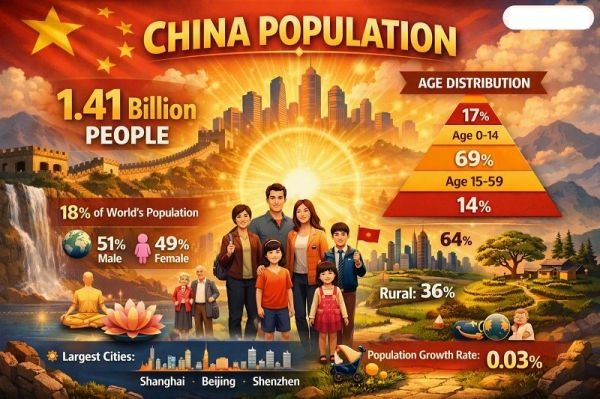
As of 2026, most demographic trackers place China’s population at roughly 1.4 billion people, though the exact figure varies slightly depending on the source and methodology used. China’s 2026 population is estimated at around 1.41 billion people, equivalent to about 17% of the total world population, ranking it second globally.
- Total population: Approximately 1.40–1.41 billion, depending on the data source
- Global rank: 2nd most populous country, after India overtook it in 2023
- Global share: China accounts for roughly 17% of the world’s total population
- Population density: About 150 people per square kilometer (390 per square mile)
- Urbanization: Around 68.7% of the population now lives in urban areas
- Median age: Roughly 41–42 years, reflecting a rapidly maturing population
The Population Is Now Shrinking
Perhaps the most significant demographic story out of China today isn’t its size — it’s its direction. China’s population peaked in 2021 at around 1.41 billion people and has been in decline ever since.
In 2025, China’s official population stood at about 1.404 billion, roughly three million lower than the previous year, marking the country’s lowest recorded birthrate since the founding of the People’s Republic in 1949.
China is currently losing population at a rate of roughly 8,400 people per day on net, a result of falling births, rising deaths, and continued net emigration.
Population figures have fallen by several million over the past year alone, a decline of roughly 0.2%.
Long-range projections suggest the decline will accelerate. The United Nations estimates China’s population could fall by around 10.5% to about 1.26 billion people by 2050, and by nearly 55% to roughly 634 million by the year 2100.
Why Is China’s Population Shrinking?
Several overlapping forces are driving this shift, and none of them are simple to reverse:
Ultra-low fertility rate: China’s fertility rate sits at approximately 0.93 children per woman, far below the replacement level of around 2.1 needed to keep a population stable.
Legacy of the one-child policy: The one-child policy, enforced from 1979 to 2015, limited urban families to a single child and rural families to two, permanently reshaping family-size expectations across generations.
Rising cost of living and child-rearing: Housing, education, and childcare costs in major Chinese cities have climbed sharply, discouraging many young couples from having multiple children — or any at all.
Delayed marriage and urbanization: As more people move to cities for education and careers, marriage and childbirth are happening later, further compressing fertility windows.
Death rate now exceeding birth rate: China’s birth rate has fallen to about 5.63 births per 1,000 people, while the death rate has climbed to roughly 8.04 deaths per 1,000, meaning deaths now outnumber births nationally.
Net emigration: China is also experiencing negative net migration, with more people leaving the country than arriving in recent years.
An Aging Nation
- Population decline is only half the story — the other half is the rapid aging of Chinese society.
- The median age in China has climbed sharply, rising from about 36 years in 2016 to roughly 40.6–41.7 years in 2026.
- For every 100 working-age people (ages 15–64), there are now about 21 children under 15 and nearly 22 people aged 65 or older — a strikingly top-heavy age structure.
- Demographers describe China’s population pyramid as “constrictive,” with a narrow base reflecting below-replacement fertility and a growing share of elderly citizens.
- Life expectancy in China has climbed to around 79 years overall, contributing further to the aging trend.
- This shift creates mounting pressure on pension systems, elder care infrastructure, and healthcare services, even as the pool of working-age taxpayers funding those systems shrinks.
Urbanization and Regional Distribution
While the national population shrinks, internal migration continues to reshape where people live.
- Nearly 69% of China’s population now lives in urban areas, a dramatic shift from the largely rural country of just a few decades ago.
- Coastal megacities like Shanghai, Beijing, Shenzhen, and Guangzhou continue to draw talent and labor, while many rural and inland provinces face population decline and aging even faster than the national average.
- The population remains ethnically concentrated, with Han Chinese making up around 91% of the total population.
Government Response
Beijing has reversed course dramatically from its old population-control policies:
- The one-child policy was replaced with a two-child policy in 2016, and a three-child policy followed in 2021.
- Various provinces now offer cash incentives, tax breaks, extended parental leave, and housing subsidies to encourage larger families.
- Despite these measures, birth rates have continued to decline, suggesting that economic and cultural factors are outweighing policy incentives.
- Some regions have also begun raising the retirement age and expanding elder care programs to prepare for a shrinking, older workforce.
Global Implications
China’s demographic shift carries consequences well beyond its borders:
Labor force contraction: A shrinking working-age population could slow China’s manufacturing output and economic growth over the coming decades.
Shifting global rankings: India has already surpassed China as the world’s most populous nation, a symbolic and strategic turning point in global demographics.
Consumer markets: An aging, shrinking population changes demand patterns — less demand for baby products and school infrastructure, more for healthcare, senior living, and pension services.
Geopolitical weight: Population size has long been tied to military and economic influence; a sustained decline could reshape long-term projections of China’s global standing.
Conclusion
China’s population story in 2026 is no longer one of unstoppable growth — it’s a story of transition. After decades as the world’s most populous nation, China is now navigating falling birth rates, a shrinking workforce, and a rapidly aging society, all while remaining home to roughly 1.4 billion people and 17% of humanity. The government’s pivot from population control to population encouragement highlights just how quickly demographic fortunes can change. How China adapts — through policy, technology, automation, and social reform — will not only shape its own economic future but will also ripple through global trade, labor markets, and geopolitics for decades to come.
FAQs
1. What is the current population of China in 2026?
China’s population in 2026 is estimated at approximately 1.40 to 1.41 billion people, depending on the data source, making it the world’s second most populous country after India.
2. Is China’s population increasing or decreasing?
China’s population is decreasing. It peaked around 2021 and has been declining since, driven by low birth rates, an aging population, and net emigration.
3. Why is China’s birth rate so low?
Factors include the lingering effects of the one-child policy, high costs of housing and child-rearing, delayed marriage due to urbanization, and cultural shifts in family planning preferences.
4. Has India really overtaken China in population?
Yes. India surpassed China as the world’s most populous country in 2023 and continues to hold that position as of 2026.
5. What is China doing to address its population decline?
China has moved from a one-child to a three-child policy, and various provinces now offer financial incentives, extended parental leave, and housing support to encourage families to have more children, though results so far have been limited.
Sources: United Nations World Population Prospects (2024 Revision), Worldometer, World Population Review, Wikipedia’s Demographics of China, and PopulationPyramid.net (2026 data).
