
Which Is the Biggest Continent in the World? A Complete Breakdown
Of all the “biggest in the world” questions people ask, this might be the one with the least room for debate. Unlike deserts or dams, where the answer shifts depending on how you measure things, the biggest continent in the world has one clear, undisputed winner: Asia.
But knowing the answer is just the starting point. In this guide, we’ll look at exactly how big Asia really is, how the remaining six continents stack up against it, and why size alone doesn’t tell the whole story of what makes a continent significant.
Which is the Biggest Desert in the World? Antarctica vs. Sahara Explained
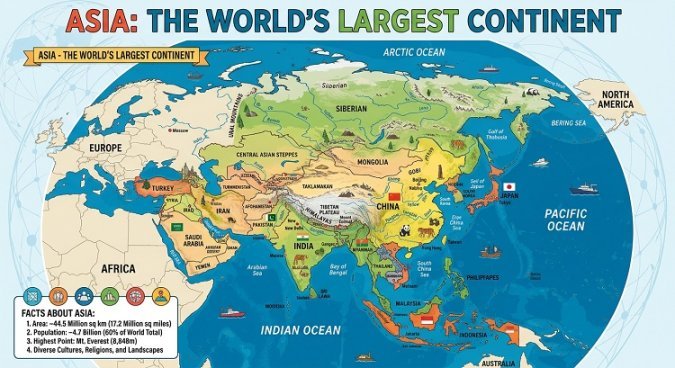
Asia: The Undisputed Largest Continent
Asia covers approximately 44.58 million square kilometers (about 17.2 million square miles), making up roughly 30% of the Earth’s total land area. To put that into perspective, Asia is larger than Africa, North America, and Europe combined. It’s also bigger than the entirety of South America and Antarctica put together.
Asia isn’t just the largest continent by land area — it’s also the most populous, home to an estimated 4.6 to 4.8 billion people, or around 60% of the world’s population. That combination of scale and population density makes Asia the dominant continent by almost every measure that matters, whether you’re looking at geography, economics, or demographics.
The continent’s sheer size means it contains an extraordinary range of geography and climate. Asia is home to Mount Everest, the highest point on Earth; Lake Baikal, the world’s deepest lake; the Gobi Desert, one of the largest cold deserts on the planet; and Siberia, the largest forest region in the world. It stretches across more than 50 degrees of latitude in the northern hemisphere alone, while also reaching into tropical zones near the equator in countries like Indonesia and Malaysia.
Why Asia Is So Much Bigger Than Everything Else
The gap between Asia and the second-largest continent isn’t small — it’s roughly equal to the entire area of Russia, or the combined area of Australia and Greenland. This enormous lead comes down to plate tectonics: Asia sits atop a vast, ancient continental landmass that has remained largely intact and connected for hundreds of millions of years, unlike smaller landmasses that broke apart earlier in Earth’s geological history.
Because Asia and Europe share a single connected landmass, they’re sometimes grouped together as “Eurasia.” When combined with Africa (connected via the Sinai Peninsula), the resulting “Afro-Eurasia” supercontinent accounts for more than 60% of Earth’s entire landmass — underscoring just how much of the world’s dry land is concentrated in this one connected region.
The Seven Continents Ranked by Size
While Asia’s dominance is clear, it helps to see the full picture. Here’s how all seven continents compare by land area:
| Rank | Continent | Approximate Area | Share of World’s Land |
|---|---|---|---|
| 1 | Asia | 44.58 million km² | ~30% |
| 2 | Africa | 30.37 million km² | ~20% |
| 3 | North America | 24.71 million km² | ~16% |
| 4 | South America | 17.84 million km² | ~12% |
| 5 | Antarctica | 14.2 million km² | ~10% |
| 6 | Europe | 10.18 million km² | ~7% |
| 7 | Australia (Oceania) | 8.6 million km² | ~6% |
Africa comes in a distant but clear second place, still large enough to hold the entirety of North America and Europe combined. Meanwhile, Australia — often called the “island continent” — ranks as the smallest of the seven, despite also being the largest island on Earth.
Africa: The Runner-Up With Its Own Records
While Asia takes the overall title, Africa deserves recognition as the second-largest continent, spanning around 30.37 million square kilometers. It’s the only continent that straddles both the Northern and Southern Hemispheres along the equator, giving it an extraordinary range of climates, from the Sahara Desert in the north — the largest hot desert in the world — to the tropical rainforests of the Congo Basin.
Africa is also home to 54 recognized sovereign nations, more countries than any other continent, and its population is growing faster than anywhere else on Earth. Some demographic projections suggest Africa’s population could approach 2.5 billion by 2050, gradually narrowing the population gap with Asia even though the land area gap will remain permanent.
Does Size Determine Importance?
It’s tempting to assume the biggest continent is automatically the “most important,” but geography rarely works that simply. Europe, for example, ranks as one of the smaller continents by land area yet has historically punched far above its size in terms of global political, economic, and cultural influence. Australia, despite being the smallest continent, is the only one that also functions as a single country, giving it a unique status in geography discussions.
Antarctica presents its own paradox: it’s the fifth-largest continent by area, larger than both Europe and Australia, yet it has no permanent population — only rotating groups of scientists and researchers who live there seasonally.
This is a useful reminder that continents can be “biggest” in different ways: by land area, by population, by economic output, or by influence — and Asia happens to lead in nearly every one of these categories simultaneously.
Quick Facts About Asia You Might Not Know
- Asia contains 49 countries, the most populous being China and India.
- Russia, though classified as a transcontinental country, has the majority of its landmass within Asia and is the largest country in the world by area.
- Asia is home to the Yangtze River, the longest river in Asia and third-longest in the world.
- The continent spans nearly every climate type on Earth, from Siberian tundra to Southeast Asian rainforests to the Arabian desert.
- Asia’s coastline touches three of the world’s five oceans: the Pacific, Indian, and Arctic Oceans.
Final Answer
So, which is the biggest continent in the world? It’s Asia, by a wide and permanent margin, covering roughly 44.58 million square kilometers and home to well over half of humanity. Africa follows as a strong second, with North America, South America, Antarctica, Europe, and Australia rounding out the list in that order.
Understanding these rankings isn’t just useful trivia — it offers a clearer picture of how unevenly land, population, and resources are distributed across our planet, and why certain regions have shaped world history, trade, and culture more than others.
Did any of these continent facts surprise you? Drop a comment below and let us know which continent you’d most like to explore next.
