
Indian Railways is the backbone of the country’s transportation system, moving crores of passengers every single day across one of the largest rail networks on the planet. Within this vast web of tracks and terminals, a handful of stations stand out for their sheer scale — massive platform counts, sprawling land area, and passenger footfalls that rival the population of small cities.
If you’ve ever wondered which stations top the list, here’s a detailed look at the ten biggest railway stations in India, ranked primarily by the number of platforms they operate, along with the history and character that make each one unique.
What are the benefits of walking?: Why the Simplest Exercise Might Be the Most Powerful
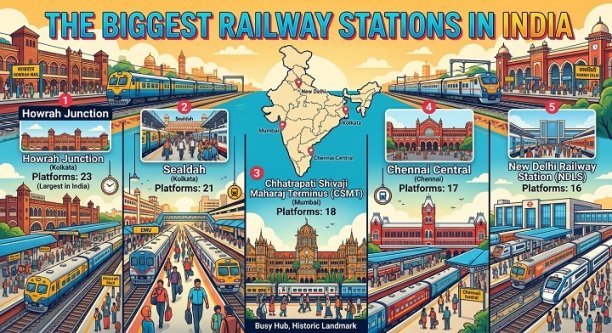
1. Howrah Junction, West Bengal
Sitting on the banks of the Hooghly River opposite Kolkata, Howrah Junction is widely regarded as the largest and busiest railway station in India. With 23 platforms and more than two dozen tracks, it handles well over a million passengers on a typical day. Opened in 1854, Howrah is also among the oldest major stations in the country and functions as a joint hub for the Eastern Railway and South Eastern Railway zones. The station is inseparable from the iconic Howrah Bridge, which connects it to the heart of Kolkata and has become a symbol of the city itself.
2. Sealdah Railway Station, West Bengal
Kolkata’s other giant, Sealdah, comes in a close second with 21 platforms. First opened in 1862, the station is split into North, Main, and South sections to manage its enormous mix of suburban commuters and long-distance travelers. Sealdah is one of the primary gateways for journeys into Northeast India, and its scale reflects just how central it is to daily life in the Kolkata metropolitan region.
3. Chhatrapati Shivaji Maharaj Terminus, Mumbai
Formerly known as Victoria Terminus, CSMT is the only station on this list with UNESCO World Heritage status. Its 18 platforms handle a staggering volume of both long-distance and suburban trains, but what truly sets it apart is its architecture — a striking blend of Victorian Gothic Revival design with traditional Indian elements. Beyond its role as a transport hub, CSMT is one of Mumbai’s most photographed landmarks and a must-see for anyone visiting the city.
4. Chennai Central, Tamil Nadu
Officially known as Puratchi Thalaivar Dr. M.G. Ramachandran Central Railway Station, Chennai Central operates 17 platforms and serves as South India’s busiest rail gateway. It connects Chennai to virtually every major metro in the country and handles several lakh passengers daily. Its red-brick colonial facade, paired with modern upgrades over the years, makes it as much an architectural landmark as a functional transit hub.
5. New Delhi Railway Station
Located at the heart of the national capital, New Delhi Railway Station runs 16 platforms and is one of the busiest interchange points in the entire network. Trains from nearly every corner of India converge here, making it a critical node for both intercity and suburban travel. Interestingly, the station began with just a single platform decades ago before growing into the sprawling complex travelers see today.
6. Secunderabad Junction, Telangana
Secunderabad Junction, with 13 platforms, is the primary rail hub for South-Central India. It links Telangana to neighboring states and plays a major role in both passenger and freight movement. Alongside Hyderabad’s other stations, Secunderabad forms a key part of the twin cities’ transport backbone.
7. Ahmedabad Junction, Gujarat
One of the oldest stations in western India, Ahmedabad Junction dates back to 1863 and today operates 12 platforms as a major node of the Western Railway zone. It’s a vital link for trains moving through Gujarat and connects the state to major commercial and industrial centers across India.
8. Gorakhpur Junction, Uttar Pradesh
Gorakhpur is famous for more than just its size — it’s home to one of the longest railway platforms in the world, a record that puts it on the map well beyond India. With 12 platforms rated at Class A+ facilities, the station manages heavy passenger and freight traffic and serves as a key junction for journeys across eastern Uttar Pradesh.
9. Kanpur Central, Uttar Pradesh
Kanpur Central operates 10 platforms and is considered one of the busiest stations in northern India. It’s a crucial link on the Delhi-Kolkata route and consistently ranks among the top three busiest stations in the country by passenger volume, right behind Howrah and New Delhi.
10. Vijayawada Junction, Andhra Pradesh
Rounding out the list is Vijayawada Junction, another 10-platform station that sits at the intersection of the Howrah-Chennai and New Delhi-Chennai rail corridors. It’s one of the busiest stations in South India, serving over a lakh passengers daily, and has even earned recognition for its environmental sustainability efforts.
What Makes These Stations So Massive?
A few common threads run through this list. Most of these stations date back to the colonial era, when British engineers first laid the foundations of India’s rail network in the mid-1800s. Their locations — Kolkata, Mumbai, Chennai, Delhi — were the commercial and administrative centers of the time, which is why the infrastructure built there needed to scale to match enormous population growth over the following century and a half.
Today, size is measured through a mix of factors: number of platforms, total land area, track count, and daily passenger footfall. Indian Railways continues to invest in modernizing these hubs, with upgrades to platform capacity, passenger amenities, and station aesthetics rolling out at several of the stations on this list in recent years.
Final Thoughts
From the UNESCO-listed grandeur of CSMT to the record-breaking platform length at Gorakhpur, India’s biggest railway stations are far more than just places to catch a train. They’re living pieces of history, engineering marvels, and daily lifelines for millions of commuters. Whether you’re a rail enthusiast planning a station-hopping trip or simply curious about the scale of India’s rail network, these ten stations offer a fascinating window into how the country moves.
Note: Platform counts and rankings are based on the most recent publicly available data and may change as Indian Railways continues expansion and modernization projects.
