
If you’ve ever spent hours re-reading a textbook chapter only to forget everything the next day, you’re not alone — and you’re not doing anything wrong as a person. You’re just using the wrong method. Decades of cognitive science research have shown that most traditional study habits, like highlighting and passive re-reading, are among the least effective ways to learn. The good news? There’s a better way, and it’s backed by real evidence.
This guide breaks down the best way to study, drawing on research from cognitive psychology and learning science, so you can spend less time studying and remember more of what you learn.
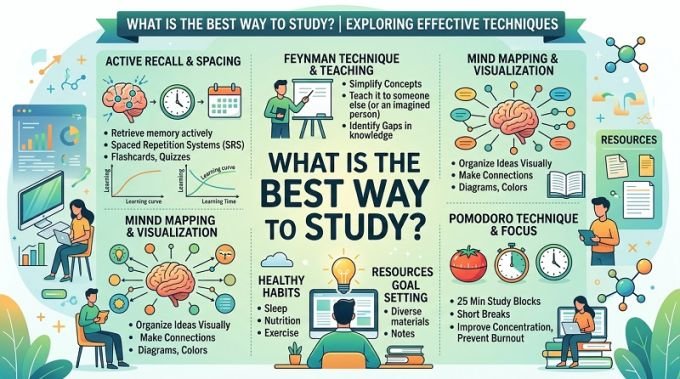
Why Most Study Habits Fail
Before diving into what works, it’s worth understanding why so many popular study techniques don’t. Highlighting text, rereading notes, and cramming the night before an exam all create a false sense of familiarity. When information looks familiar, your brain tricks you into thinking you know it — but recognition is not the same as recall. On a test, you need to retrieve information from memory, not just recognize it when you see it again.
This is why students who feel confident after hours of rereading often underperform compared to those who use retrieval-based techniques, even when the latter group studies for less time.
1. Active Recall: The Gold Standard
Active recall is widely considered the single most effective study technique. Instead of passively reviewing material, you actively test yourself on it. This could mean:
- Closing your book and writing down everything you remember about a topic
- Using flashcards and trying to answer before flipping them over
- Creating practice questions and quizzing yourself
Every time you struggle to retrieve information from memory, you strengthen the neural pathways associated with that knowledge. This “desirable difficulty” is uncomfortable in the moment, but it’s exactly what makes the information stick long-term.
How to apply it: After reading a section of material, close the book and try to summarize the key points from memory before checking your notes.
2. Spaced Repetition: Timing Is Everything
Cramming might help you pass tomorrow’s quiz, but it does almost nothing for long-term retention. Spaced repetition works by reviewing material at increasing intervals over time — a day later, then a few days later, then a week later, and so on.
This technique takes advantage of the “spacing effect,” a well-documented psychological phenomenon showing that information is better retained when learning sessions are spread out rather than crammed together.
How to apply it: Use a spaced repetition app or simply schedule review sessions on a calendar, revisiting material at gradually increasing intervals rather than studying it all at once.
3. The Pomodoro Technique: Focus in Short Bursts
Long, unfocused study marathons often lead to burnout and diminishing returns. The Pomodoro Technique breaks study time into short, focused intervals (typically 25 minutes) followed by a 5-minute break. After four rounds, you take a longer break of 15–30 minutes.
This method works because it aligns with how attention naturally fluctuates. Instead of forcing focus for hours, you work with your brain’s limits rather than against them.
How to apply it: Set a timer for 25 minutes, eliminate distractions, and work on a single task. When the timer goes off, take a real break — step away from your desk and phone.
4. Interleaving: Mix It Up
Interleaving means studying multiple related topics or skills in a single session instead of focusing on just one at a time. For example, instead of solving twenty of the same type of math problem in a row, you’d mix different problem types together.
While this feels harder and slower in the moment, research shows it leads to better long-term learning and improved ability to apply knowledge to new situations, because your brain has to work harder to distinguish between concepts.
How to apply it: When studying for exams covering multiple topics, rotate between subjects or problem types rather than mastering one completely before moving to the next.
5. Elaboration: Connect New Information to What You Know
Elaboration involves explaining and describing ideas in detail, and connecting new information to things you already understand. Ask yourself “why” and “how” questions as you study.
For instance, instead of memorizing that “mitochondria produce energy,” ask yourself why that matters and how it connects to other cell functions. This deeper processing creates stronger memory traces than surface-level memorization.
How to apply it: After learning a new concept, try teaching it to someone else — or even to an imaginary audience. If you can’t explain it simply, you don’t understand it well enough yet.
6. Sleep and Study: An Underrated Combination
No study technique can compensate for chronic sleep deprivation. Sleep plays a critical role in memory consolidation — the process by which your brain transfers information from short-term to long-term memory. Pulling an all-nighter before an exam is often counterproductive, as it undermines the very process your brain needs to lock in what you just studied.
How to apply it: Prioritize consistent, quality sleep, especially in the days leading up to an exam. A well-rested brain retains information far better than an exhausted one.
Putting It All Together: A Sample Study Routine
Here’s what an evidence-based study session might look like in practice:
- Choose a topic and set a 25-minute timer (Pomodoro)
- Read or review the material once
- Close your notes and write down everything you remember (active recall)
- Check your notes and fill in gaps
- Take a 5-minute break
- Move to a different but related topic (interleaving)
- Schedule a follow-up review in 2–3 days (spaced repetition)
Final Thoughts
The best way to study isn’t about working harder — it’s about working smarter, using techniques that align with how memory actually works. Active recall and spaced repetition alone can dramatically improve retention, and combining them with focused work intervals, interleaved practice, and proper sleep creates a study system that’s both efficient and sustainable.
Ditch the highlighters and the all-night cramming sessions. Try one of these techniques in your next study session, and you may be surprised at how much more you remember — with far less effort than you expected.
