
Few phrases capture the imagination quite like “the Seven Wonders of the World.” The idea dates back over two thousand years, when ancient travelers and scholars began compiling lists of the most awe-inspiring structures known to humanity. Today, when people say “Seven Wonders,” they’re usually referring to one of two different lists: the Ancient Seven Wonders, compiled by Greek scholars, and the New Seven Wonders, chosen through a global public vote in 2007. Both lists tell a story about human ambition, engineering, and cultural achievement — just from very different eras.
Here’s a complete look at both lists, what makes each site remarkable, and why they continue to capture the world’s fascination.
The Original: Seven Wonders of the Ancient World
The ancient list was first outlined by Greek writers around the 2nd century BCE, highlighting the most remarkable monuments known in the Mediterranean and Near Eastern world at the time. Of the seven, only one survives today.
1. Great Pyramid of Giza (Egypt) — The oldest and only surviving wonder of the ancient list, built around 2560 BCE as a tomb for Pharaoh Khufu. It remained the tallest man-made structure on Earth for nearly 3,800 years.
2. Hanging Gardens of Babylon (Iraq) — Described as a lush, tiered garden rising in the middle of the desert. Its existence is debated among historians, with some scholars believing it may have been located in Nineveh rather than Babylon, or may be partly legendary.
3. Statue of Zeus at Olympia (Greece) — A massive seated statue of the god Zeus, crafted by the sculptor Phidias, said to be so large that Zeus’s head nearly touched the temple ceiling.
4. Temple of Artemis at Ephesus (Turkey) — A grand marble temple dedicated to the goddess Artemis, rebuilt multiple times after destruction by flooding and fire.
5. Mausoleum at Halicarnassus (Turkey) — An elaborate tomb built for Mausolus, a Persian satrap, whose name became the origin of the word “mausoleum.”
6. Colossus of Rhodes (Greece) — A towering bronze statue of the sun god Helios, erected at the harbor of Rhodes, destroyed by an earthquake roughly 60 years after completion.
7. Lighthouse of Alexandria (Egypt) — One of the tallest structures of the ancient world, guiding ships into the harbor of Alexandria for centuries before being toppled by earthquakes.
The Modern List: New Seven Wonders of the World
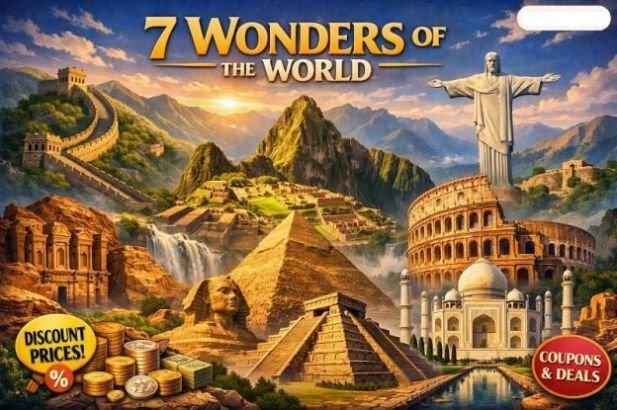
In 2007, the New7Wonders Foundation organized a global poll, drawing over 100 million votes, to select a new set of wonders reflecting surviving monuments from around the world.
1. Great Wall of China — Stretching thousands of miles across northern China, this series of fortifications was built over centuries to protect against invasions, and remains one of the largest construction projects in human history.
2. Petra (Jordan) — An ancient city carved directly into rose-colored sandstone cliffs, once a thriving trade hub for the Nabataean civilization, later rediscovered by Western explorers in the 19th century.
3. Christ the Redeemer (Brazil) — A massive Art Deco statue of Jesus Christ overlooking Rio de Janeiro from atop Corcovado Mountain, completed in 1931 and recognized as a symbol of Brazilian identity.
4. Machu Picchu (Peru) — A 15th-century Incan citadel set high in the Andes Mountains, remarkably preserved and believed to have served as a royal estate or religious site.
5. Chichen Itza (Mexico) — A major city of the ancient Maya civilization, home to the iconic step-pyramid known as El Castillo, which aligns with astronomical events during the equinoxes.
6. Roman Colosseum (Italy) — An enormous amphitheater in the heart of Rome, once host to gladiatorial contests and public spectacles, and still one of the most visited historical sites on Earth.
7. Taj Mahal (India) — A white marble mausoleum built by Mughal Emperor Shah Jahan in memory of his wife Mumtaz Mahal, widely regarded as one of the finest examples of Mughal architecture.
(The Great Pyramid of Giza was given honorary status as the only surviving ancient wonder and wasn’t included in the public vote for the new list.)
Why These Wonders Still Matter
Both lists represent more than just impressive architecture. They reflect the values, beliefs, and technological capabilities of the civilizations that built them — from religious devotion and political power to trade, astronomy, and artistic ambition. Visiting or learning about these sites offers a tangible connection to human history that textbooks alone can’t fully capture.
The New7Wonders also reflect a more globally representative view of human achievement than the original ancient list, which was limited almost entirely to sites known within the Mediterranean world. The modern list spans four continents and includes civilizations from Asia, the Middle East, South America, and Europe.
The Bottom Line
The Seven Wonders of the World, whether ancient or modern, capture something timeless about human creativity and determination. From a pyramid engineered without modern machinery to a citadel built into the clouds of the Andes, these structures continue to inspire awe precisely because they demonstrate what people can accomplish when ambition meets ingenuity. Whether you’re planning a trip or simply curious about history, understanding both lists offers a richer appreciation for how humanity has expressed its greatest achievements across thousands of years.
Quick Facts: Seven Wonders at a Glance
- The original Seven Wonders list was compiled by Greek scholars around the 2nd century BCE
- The Great Pyramid of Giza is the only ancient wonder that still survives today
- The Hanging Gardens of Babylon’s exact location and existence remain debated by historians
- The New Seven Wonders were chosen in a 2007 global public vote with over 100 million votes cast
- The Great Wall of China is one of the largest construction projects in human history
- Petra was carved directly into sandstone cliffs by the Nabataean civilization
- Christ the Redeemer in Brazil was completed in 1931 and overlooks Rio de Janeiro
- Machu Picchu sits high in Peru’s Andes Mountains and dates to the 15th century
- Chichen Itza’s El Castillo pyramid aligns with astronomical events during the equinoxes
- The Roman Colosseum once hosted gladiatorial contests and public spectacles
- The Taj Mahal was built by Emperor Shah Jahan as a mausoleum for his wife
- The Great Pyramid received honorary status and wasn’t part of the 2007 public vote
Frequently Asked Questions (FAQs)
1. Which of the ancient Seven Wonders still exists today?
Only the Great Pyramid of Giza in Egypt survives. The other six were destroyed over the centuries by natural disasters, fires, or the passage of time.
2. Who decided the New Seven Wonders of the World?
The New7Wonders Foundation organized a global public vote in 2007, in which more than 100 million people worldwide cast votes to select the modern list.
3. Why wasn’t the Great Pyramid included in the 2007 vote?
Since it’s the only surviving ancient wonder, organizers gave it honorary status on the New Seven Wonders list rather than including it in the public voting process.
4. Is the Hanging Gardens of Babylon a real historical site?
Its existence is debated. Some historians believe it existed in Babylon, others argue it may have been located in Nineveh, and some consider it partly or entirely legendary due to limited archaeological evidence.
5. Which of the Seven Wonders is the oldest?
The Great Pyramid of Giza is the oldest, built around 2560 BCE, making it roughly 4,500 years old.
