
How to Build Muscle Tag Wellhealth: The Complete Science-Backed Guide
Building muscle isn’t about chasing the latest fitness fad or spending three hours a day in the gym. It’s about consistently applying a handful of proven principles: progressive overload, adequate protein intake, sufficient recovery, and patience. Whether you’re a complete beginner or someone who’s been lifting for a while but has hit a plateau, this guide breaks down exactly how to build muscle in a way that’s sustainable and backed by science.
What are the benefits of walking?: Why the Simplest Exercise Might Be the Most Powerful
Understanding How Muscle Growth Actually Works
Muscle growth, technically called hypertrophy, happens when muscle fibers experience microscopic damage during resistance training and then repair themselves to become larger and stronger. This process depends on three core factors working together:
- Mechanical tension – the stress placed on muscles during resistance exercise
- Muscle damage – the microtrauma caused by challenging workouts
- Metabolic stress – the “burn” you feel from higher-rep training
None of these factors work in isolation. A well-designed training program combines all three, but mechanical tension through progressive overload is the most important driver of long-term muscle growth.
Principle 1: Progressive Overload Is Non-Negotiable
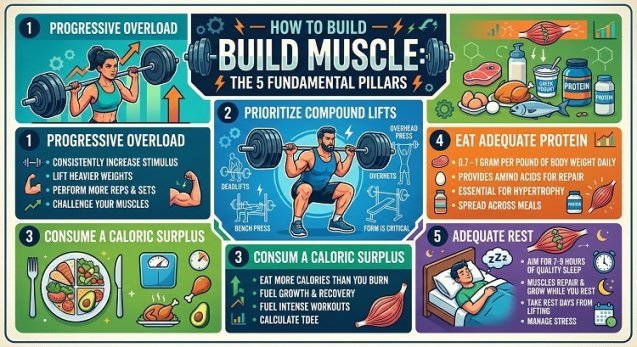
If there’s one rule that matters more than any other in building muscle, it’s progressive overload. This simply means gradually increasing the demands placed on your muscles over time — whether through more weight, more reps, more sets, or better technique.
Your body adapts quickly to a fixed stimulus. If you lift the same weight for the same reps every week, your muscles have no reason to keep growing. To build muscle consistently, you need to:
- Increase the weight you lift once a movement feels manageable
- Add an extra rep or set to your workouts over time
- Improve your range of motion and control
- Reduce rest periods to increase training density (used sparingly)
Track your workouts in a notebook or app. Progress that isn’t measured is progress that’s easy to lose track of.
Principle 2: Train With the Right Volume and Frequency
Research consistently shows that training each muscle group multiple times per week produces better results than the old-school approach of hitting one muscle group per week (“bro splits”). A muscle group trained twice a week generally grows faster than one trained only once, assuming total volume is comparable.
For most people building muscle, a good starting point looks like:
- 10–20 sets per muscle group per week, split across two to three sessions
- 6–15 reps per set for most compound and isolation exercises
- 48–72 hours of recovery before training the same muscle group again
A practical split for beginners might be an upper/lower body routine four days a week, while intermediate lifters often benefit from a push/pull/legs split repeated twice weekly.
Principle 3: Prioritize Compound Movements
Compound exercises work multiple muscle groups and joints simultaneously, giving you more muscle-building stimulus per minute in the gym. These should form the backbone of any effective muscle-building program:
- Squats – quads, glutes, hamstrings, core
- Deadlifts – hamstrings, glutes, back, grip
- Bench press – chest, shoulders, triceps
- Overhead press – shoulders, triceps, core
- Pull-ups and rows – back, biceps, grip
Isolation exercises like bicep curls, tricep extensions, and lateral raises still have a place — they help target specific muscles that might lag behind — but they should supplement, not replace, compound lifts.
Principle 4: Nutrition Fuels the Growth
You cannot out-train a poor diet. Muscle building requires a caloric surplus, meaning you eat slightly more calories than you burn, giving your body the raw materials and energy needed to repair and build new tissue.
Protein Intake
Protein is the most critical macronutrient for muscle repair and growth. Most research supports a daily intake of roughly 1.6 to 2.2 grams of protein per kilogram of body weight (about 0.7–1 gram per pound) for people actively training for hypertrophy. Good sources include:
- Chicken, turkey, and lean beef
- Eggs and dairy products
- Fish, especially salmon and tuna
- Legumes, tofu, and tempeh for plant-based eaters
- Whey or plant-based protein powder to fill gaps
Carbohydrates and Fats
Carbohydrates replenish glycogen stores and fuel intense training sessions, while fats support hormone production, including testosterone, which plays a role in muscle growth. A balanced approach — roughly 45-55% of calories from carbs, 20-30% from protein, and 20-30% from fats — works well for most people, though individual needs vary based on activity level and body composition goals.
Caloric Surplus: How Much Is Enough?
A surplus of 250 to 500 calories above maintenance is generally enough to support muscle growth without excessive fat gain. Going too aggressive with your surplus doesn’t accelerate muscle building — it just adds unnecessary body fat.
Principle 5: Recovery Is Where Growth Happens
Muscles don’t grow in the gym; they grow during rest. Training breaks muscle fibers down, but recovery is when they rebuild bigger and stronger. Neglecting recovery is one of the most common reasons people struggle to build muscle despite training hard.
Sleep
Aim for 7 to 9 hours of quality sleep per night. Sleep is when the body releases the majority of its growth hormone and repairs damaged tissue. Chronic sleep deprivation has been linked to reduced strength gains and impaired recovery.
Rest Days
Give each muscle group at least 48 hours before training it again. Overtraining without adequate recovery can lead to stalled progress, increased injury risk, and burnout.
Stress Management
Chronic stress elevates cortisol, a hormone that can interfere with muscle repair and promote fat storage. Simple habits like walking, meditation, or spending time outdoors can help keep stress levels in check.
Principle 6: Supplements — What Actually Works
Supplements aren’t magic, but a few have solid research behind them:
- Creatine monohydrate – one of the most studied supplements, shown to improve strength and muscle mass when combined with resistance training
- Whey or plant protein powder – convenient way to hit daily protein targets
- Caffeine – can improve workout performance and focus
- Beta-alanine – may help with endurance during high-rep training
Most other supplements marketed for “explosive muscle growth” lack strong evidence. Prioritize training, nutrition, and sleep before spending money on supplements.
Common Mistakes That Slow Muscle Growth
Even well-intentioned lifters make mistakes that hold back their progress:
- Program hopping – switching routines every few weeks prevents your body from adapting and progressing
- Neglecting form – lifting heavier weights with poor technique increases injury risk and reduces muscle activation
- Under-eating protein – especially common among people trying to build muscle while also losing fat
- Skipping warm-ups – proper warm-ups improve performance and reduce injury risk
- Chasing soreness – extreme muscle soreness isn’t a reliable indicator of an effective workout
- Ignoring sleep and stress – training hard while under-recovering leads to diminishing returns
Sample Weekly Training Split for Muscle Building
For those looking for a practical starting point, here’s a simple four-day split:
- Day 1: Upper body push (chest, shoulders, triceps)
- Day 2: Lower body (quads, hamstrings, glutes)
- Day 3: Rest or light cardio
- Day 4: Upper body pull (back, biceps)
- Day 5: Lower body and core
- Day 6–7: Rest or active recovery
This structure allows each muscle group to be trained roughly twice per week while providing enough recovery between sessions.
How Long Does It Take to Build Muscle?
Realistic expectations matter. Beginners can often gain 1 to 2 pounds of muscle per month, while more experienced lifters typically see slower gains of a few pounds per year as they approach their genetic potential. Visible changes usually become noticeable within 8 to 12 weeks of consistent training and proper nutrition, though the process of building significant muscle mass takes months to years of sustained effort.
Final Thoughts
Building muscle isn’t complicated, but it does require consistency. Progressive overload in the gym, adequate protein and calories on your plate, quality sleep, and patience over time are the real foundations of muscle growth. Skip the shortcuts and gimmicks, focus on the fundamentals outlined here, and the results will follow.
