
Organic chemistry students preparing for board exams and competitive tests like JEE, NEET, and CBSE Class 12 frequently come across a deceptively simple question: Which of the following reactions produces acetyl chloride? This question tests your understanding of carboxylic acid derivatives, nucleophilic acyl substitution, and the role of chlorinating agents in organic synthesis. In this guide, we break down the correct reaction, the underlying chemistry, and the many forms in which examiners like to ask it.
What Is Acetyl Chloride?
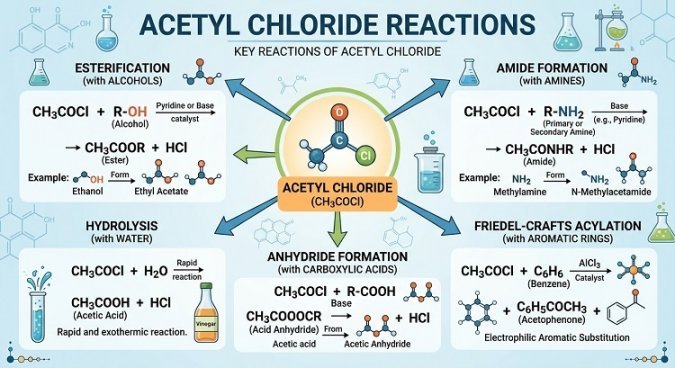
Acetyl chloride (CH₃COCl) is the acid chloride derivative of acetic acid (CH₃COOH). It belongs to a class of compounds called acyl halides, which are among the most reactive carboxylic acid derivatives. Because of its high reactivity, acetyl chloride is a key reagent in acetylation reactions, used to introduce the acetyl group (CH₃CO–) into alcohols, phenols, and amines to form esters and amides.
Its reactivity comes from the electronegative chlorine atom attached to the carbonyl carbon, which makes that carbon highly electrophilic and susceptible to nucleophilic attack — a property examiners love to test alongside its preparation.
The Reaction That Produces Acetyl Chloride
Acetyl chloride is prepared by treating acetic acid with a chlorinating agent that replaces the –OH group of the carboxylic acid with a chlorine atom. Three reagents are commonly used for this conversion, and any of them can appear as the “correct answer” depending on how the question is framed:
1. Reaction with Phosphorus Pentachloride (PCl₅)
CH₃COOH + PCl₅ → CH₃COCl + POCl₃ + HCl
This is the most frequently cited reaction in textbooks. Acetic acid reacts with phosphorus pentachloride to give acetyl chloride, phosphorus oxychloride (POCl₃), and hydrogen chloride gas as by-products.
2. Reaction with Phosphorus Trichloride (PCl₃)
3CH₃COOH + PCl₃ → 3CH₃COCl + H₃PO₃
Here, three moles of acetic acid react with one mole of phosphorus trichloride to yield acetyl chloride along with phosphorous acid (H₃PO₃).
3. Reaction with Thionyl Chloride (SOCl₂)
CH₃COOH + SOCl₂ → CH₃COCl + SO₂ + HCl
This is considered the cleanest and most preferred method in both laboratories and exams because the by-products (sulfur dioxide and hydrogen chloride) are gases that escape the reaction mixture, leaving behind pure acetyl chloride without the need for extensive purification.
Exam takeaway: If a question asks for the “best” or “most suitable” method to prepare acetyl chloride, the answer is almost always the reaction of acetic acid with thionyl chloride (SOCl₂), precisely because of this easy separation of by-products.
Why Thionyl Chloride Is the Preferred Reagent
Examiners often frame this as a reasoning-based question rather than a straightforward one. The logic behind preferring SOCl₂ over PCl₅ or PCl₃ includes:
- Gaseous by-products (SO₂ and HCl) escape naturally, simplifying purification.
- No solid residue is left behind, unlike POCl₃ or H₃PO₃, which require additional separation steps.
- Higher yield and purity of acetyl chloride is obtained.
- It is a safer and more efficient industrial process for large-scale acetylation reactions.
Understanding this reasoning is crucial because many exams don’t just ask “which reaction” but also “why is this reaction preferred,” making conceptual clarity more valuable than rote memorization.
Where This Question Is Commonly Asked
This topic falls under the broader chapter of Aldehydes, Ketones, and Carboxylic Acids, typically covered in Class 12 Chemistry. It is a recurring topic across multiple exam formats:
- CBSE Class 12 Board Exams — often appears as a 1-2 mark short-answer or MCQ question.
- JEE Main and JEE Advanced — tested as part of reaction mechanism and reagent-based MCQs.
- NEET (Biology + Chemistry) — frequently included in the organic chemistry section.
- State Board Exams (UP Board, Maharashtra Board, etc.) — appears in unit tests and practice papers.
- Chemistry Olympiads and other competitive entrance exams where reagent identification is tested.
- University-level general and organic chemistry courses for undergraduate students.
Because acyl chloride preparation connects to broader concepts like nucleophilic substitution, esterification, and Friedel-Crafts acylation, it’s also a favorite topic for viva voce and practical exam questions in chemistry labs.
Other Ways This Question Can Be Asked
Exam setters rarely repeat the exact same phrasing every year. Here are several alternate forms in which this concept is tested:
- “Which of the following reagents converts acetic acid into acetyl chloride?”
- “Identify the reaction used in the industrial preparation of acetyl chloride.”
- “Which reagent is preferred for preparing acetyl chloride and why?”
- “Acetic acid on treatment with SOCl₂ gives which product?”
- “Write the equation for the conversion of acetic acid to acetyl chloride.”
- “Which of the following is NOT used to prepare acetyl chloride: PCl₅, PCl₃, SOCl₂, or NaOH?”
- “Name the by-products formed when acetic acid reacts with thionyl chloride.”
- “Why is thionyl chloride preferred over phosphorus pentachloride for preparing acyl chlorides?”
- “Assertion-Reason type: Assertion — Acetyl chloride is prepared using SOCl₂. Reason — By-products are gaseous and easily removed.”
- “Match the following: Reagent (PCl₅, PCl₃, SOCl₂) with Product/By-product (POCl₃, H₃PO₃, SO₂+HCl).”
- “Which method of preparing acetyl chloride does not require further purification?”
- “In the laboratory, acetyl chloride is best prepared by reacting acetic acid with ______.”
These variations test the same underlying concept but assess it through direct recall, reasoning, assertion-reason logic, or matching-type formats — all common in Indian competitive and board exam patterns.
Quick Revision Summary
| Reagent | Equation | By-products | Preferred? |
|---|---|---|---|
| PCl₅ | CH₃COOH + PCl₅ → CH₃COCl + POCl₃ + HCl | POCl₃, HCl | No |
| PCl₃ | 3CH₃COOH + PCl₃ → 3CH₃COCl + H₃PO₃ | H₃PO₃ | No |
| SOCl₂ | CH₃COOH + SOCl₂ → CH₃COCl + SO₂ + HCl | SO₂, HCl (gases) | Yes |
Conclusion
The question “which reaction produces acetyl chloride” is a foundational concept in organic chemistry that tests both factual recall and conceptual reasoning. While acetic acid reacts with PCl₅, PCl₃, and SOCl₂ to all yield acetyl chloride, the reaction with thionyl chloride (SOCl₂) stands out as the preferred method in both exams and industrial applications due to its clean, gaseous by-products. Mastering this reaction — along with its reasoning, equations, and alternate question formats — will help students confidently tackle this topic across CBSE boards, JEE, NEET, and other competitive exams.
