
A few years ago, “the metaverse” was one of the most hyped words in tech — a promised digital universe where we’d work, socialize, shop, and play through virtual reality headsets. Facebook even renamed itself Meta to signal its commitment to the idea. But in 2026, the metaverse looks very different from the sci-fi vision originally sold to the public. This guest post explains what the metaverse actually is, how it works, what happened to the early hype, and where the concept realistically stands today.
Read Also What is the meaning of life – Exploring Humanity’s Oldest Question
What Does “Metaverse” Actually Mean?
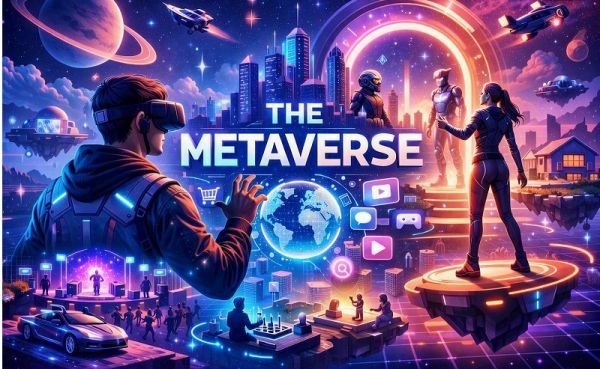
At its core, the metaverse refers to a persistent, interconnected network of 3D virtual spaces where people can interact, socialize, work, and transact — often through avatars, and often accessed via virtual reality (VR) or augmented reality (AR) devices.
Persistent: Unlike a video game session that ends, metaverse spaces are meant to continue existing and evolving even when a user logs off.
Interconnected: In its idealized form, the metaverse isn’t one single app or platform — it’s meant to be an interoperable network of many virtual worlds you can move between.
Immersive: Most metaverse concepts rely on 3D environments, spatial audio, and avatars to create a sense of “presence,” rather than flat 2D screens.
Economically active: Many metaverse platforms include their own economies — virtual goods, virtual real estate, and sometimes blockchain-based currencies or NFTs.
Social by design: The metaverse is fundamentally about shared experience — attending events, meeting friends, or collaborating with coworkers inside a virtual space rather than a video call.
The Origins of the Term
The word “metaverse” didn’t originate in Silicon Valley — it came from science fiction.
- The term was coined by author Neal Stephenson in his 1992 novel Snow Crash, where it described a virtual reality successor to the internet.
- Similar concepts appeared in other media, most notably Ready Player One, which popularized the idea of a fully immersive virtual world for mainstream audiences.
- The concept gained massive real-world traction in 2021, when Facebook rebranded as Meta Platforms and pledged to build metaverse technology.
Key Technologies Behind the Metaverse
Building a functioning metaverse depends on a stack of interconnected technologies:
Virtual reality (VR): Headsets that fully immerse users in a 3D digital environment, blocking out the physical world.
Augmented reality (AR): Technology that overlays digital elements onto the real world, often through smart glasses or mobile devices.
Mixed reality (MR): A blend of VR and AR, allowing digital and physical elements to interact in real time.
3D avatars: Digital representations of users that move, gesture, and communicate within virtual spaces.
Blockchain and digital ownership: Some metaverse platforms use blockchain technology to let users buy, sell, and verify ownership of virtual land, items, or collectibles.
Cloud computing and networking: Persistent, multi-user 3D worlds require significant computing power and low-latency networks to function smoothly.
Artificial intelligence: Increasingly, AI powers non-player characters, environment generation, and personalized experiences within virtual worlds.
What Happened to the Metaverse Hype?
The metaverse was once framed as the “next internet.” That vision hasn’t played out as originally promised.
- Meta’s flagship metaverse platform, Horizon Worlds, launched with public access in December 2021, but interest in it has faded considerably since.
- By 2026, the metaverse has been relegated largely to niche use cases, mixed reality experimentation, and enterprise tools rather than becoming a dominant consumer platform.
- Major technology companies have shifted their investment priorities toward artificial intelligence and spatial computing instead of pouring resources into standalone virtual worlds.
- Prominent platforms like Decentraland and The Sandbox are still operating, but user numbers and virtual land sales remain far below their early hype-driven peaks.
- Most people still do not reach for a VR headset to attend a meeting, browse a virtual store, or spend time with friends, and several high-profile consumer metaverse projects have struggled to retain regular users.
Why the Original Vision Struggled
Several practical barriers have slowed metaverse adoption:
Expensive hardware: High-quality VR headsets remain costly, creating a real barrier to mainstream adoption for casual users.
Comfort and usability issues: Motion sickness, headset weight, and limited battery life continue to discourage extended use.
Lack of interoperability: Different metaverse platforms remain largely siloed, with limited standards allowing avatars or digital assets to move seamlessly between them.
Latency and technical limitations: Building a smooth, realistic, multi-user virtual environment still requires infrastructure that is costly and complex to implement at scale.
Competing consumer habits: People have shown a strong preference for the convenience of phones and existing social platforms over the effort required to enter a virtual world.
Where the Metaverse Concept Is Actually Succeeding
Rather than disappearing, the metaverse has fragmented into more practical, targeted applications.
- The most credible elements of the metaverse today have moved into gaming platforms, augmented-reality devices, industrial digital twins, immersive training, and AI-powered simulations.
- Training remains one of the strongest real-world use cases, with sectors like healthcare, manufacturing, and defense reporting fewer errors after VR-based training programs.
- Design and engineering teams increasingly use shared 3D virtual spaces to review products together, cutting down on travel time and speeding up feedback.
- Mixed reality — blending digital layers with the physical world — has gained more traction than fully immersive virtual reality.
- Gaming platforms with social and creative elements, such as user-generated worlds, continue to embody many “metaverse” principles without necessarily using the term.
Is the Metaverse Still a Big Business Opportunity?
Despite the cooled hype, analysts still see significant long-term commercial potential:
- The global metaverse market was estimated at roughly $105 billion in 2024, with projections suggesting it could reach nearly $937 billion by 2030, growing at a compound annual rate of over 46%.
- Some forecasts suggest the metaverse could generate as much as $5 trillion in value by 2030, with the largest opportunities tied to e-commerce, education, advertising, and gaming.
- Industrial applications, such as maintenance and workforce training, are expected to remain among the strongest use cases for AR and VR technology through 2026 and beyond.
The Bigger Picture: Metaverse 2.0
Rather than being “dead,” many analysts describe the metaverse as entering a quieter, more mature phase.
- Instead of one flashy, unified metaverse takeover, the trend in 2026 is a gradual merging of gaming, social, and branded virtual experiences into everyday digital life.
- This “Metaverse 2.0” approach treats immersive technology as a feature woven into existing platforms, rather than a separate, standalone universe users must opt into.
- AI is increasingly seen as a companion technology to the metaverse, powering more realistic avatars, dynamic environments, and personalized virtual experiences.
Conclusion
The metaverse hasn’t disappeared — it’s evolved. What started as a bold, singular vision of one unified virtual universe has splintered into more grounded, practical applications: enterprise training, industrial digital twins, mixed-reality tools, and gaming-adjacent social platforms. The dream of millions of people spending their days in VR headsets, working and socializing in a persistent 3D world, remains largely unrealized in 2026, held back by cost, comfort, and interoperability challenges. Yet beneath the faded hype, the underlying technologies — VR, AR, 3D avatars, digital economies, and AI-driven environments — continue to mature quietly in the background. Whether or not it’s called “the metaverse,” the broader shift toward immersive, spatial computing is still very much underway, just unfolding more slowly and pragmatically than early predictions suggested.
FAQs
1. What exactly is the metaverse?
The metaverse refers to a persistent, interconnected network of 3D virtual spaces where people interact, socialize, work, and transact, typically through avatars and often accessed via VR or AR devices.
2. Is the metaverse still relevant in 2026?
It’s less hyped than it was in 2021, but it hasn’t disappeared. Its most successful applications today are in enterprise training, industrial digital twins, mixed reality, and gaming, rather than as a mainstream consumer platform.
3. Do I need a VR headset to access the metaverse?
Not necessarily. While many metaverse experiences use VR headsets, others are accessible through AR-enabled devices, smart glasses, or even standard screens, depending on the platform.
4. Why did Meta’s metaverse vision underperform expectations?
Expensive hardware, usability issues like motion sickness, limited interoperability between platforms, and technical constraints around latency and realism all slowed mainstream adoption.
5. What’s the difference between the metaverse and virtual reality?
Virtual reality is a technology used to create immersive 3D experiences, while the metaverse is a broader concept describing a persistent, interconnected virtual world — VR is one of the tools used to access it, not the concept itself.

One thought on “What Is the Metaverse? A Complete Guide to the Concept, Technology, and Reality in 2026”