
Introduction
If you’re preparing for SSC, Railway, UPSC, or State PCS exams, you’ve probably come across a question that reads: “Which one of the following is a chemical change?” This is one of the most frequently repeated General Science questions in Indian competitive exams, and despite looking like basic school-level science, it consistently trips up candidates who haven’t built strong conceptual clarity.
In this guide, we’ll cover everything you need to know about chemical change questions for competitive exams — the underlying concept, real exam examples, the different question formats you’ll encounter, and a complete list of exams where this topic is regularly tested.
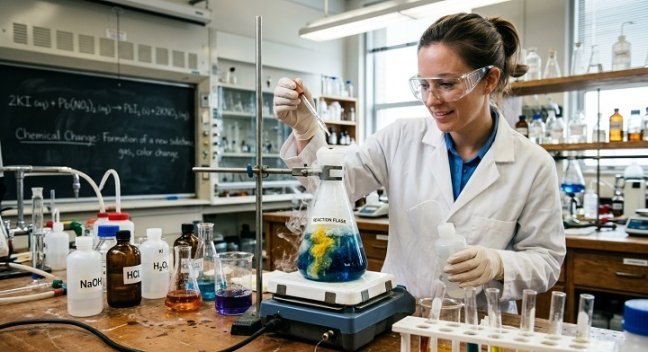
What Is a Chemical Change? (Quick Definition)
A chemical change occurs when a substance transforms into one or more new substances with entirely different chemical properties. Unlike a physical change, a chemical change is usually irreversible and cannot be undone by simple physical methods like heating, cooling, or applying pressure.
Key Indicators of a Chemical Change
When answering “which one of the following is a chemical change” type questions, look for these telltale signs:
- Color change (e.g., iron turning reddish-brown when rusting)
- Gas or bubble formation (e.g., baking soda reacting with vinegar)
- Heat or light release (e.g., burning of fuel)
- Precipitate formation (e.g., mixing certain salt solutions)
- Change in odor (e.g., milk turning sour)
- Formation of a completely new substance
Common Examples of Chemical Change
- Rusting of iron
- Burning of wood, paper, or coal
- Digestion of food
- Souring of milk
- Cooking of an egg
- Photosynthesis in plants
- Burning of a candle wick (combustion of wax vapor)
Common Examples of Physical Change (Often Used as Distractors)
- Melting of ice or wax
- Boiling or freezing of water
- Cutting or tearing of paper
- Dissolving sugar or salt in water
- Stretching a rubber band
- Crushing a can
Sample Exam Question
Which one of the following is a chemical change? (a) Melting of wax (b) Boiling of water (c) Rusting of iron (d) Cutting of a tree
Answer: (c) Rusting of iron — because it produces a new chemical compound (iron oxide), unlike the other three options, which are purely physical changes.
This example illustrates why “which one of the following is a chemical change” questions are so popular — they combine simple, everyday examples with just enough overlap to test real understanding, not memorization.
How Many Types of “Chemical Change” Questions Appear in Exams?
Based on an analysis of previous year papers, this topic is tested in 7 distinct question formats across competitive exams:
1. Direct MCQ Format
The standard version with four options, where candidates identify the single chemical change among mostly physical change options.
2. Reverse/Negative Format
Framed as “Which one of the following is NOT a chemical change?” — testing whether candidates can spot the odd physical change hidden among chemical ones.
3. Assertion-Reason Format
Common in slightly tougher exams. A statement and a reason are given, and candidates must evaluate whether both are true and logically connected.
4. Match the Following Format
Candidates match a list of processes (rusting, melting, evaporation, burning) with the correct classification: physical or chemical change.
5. Passage/Statement-Based Format
Seen occasionally in UPSC Prelims, where a scientific process is described in a sentence or two, and candidates must infer the type of change.
6. True/False Format
A simpler variant frequently used in Railway and SSC MTS/GD level exams for quick screening.
7. Application/Scenario-Based Format
Instead of naming the process directly, a real-life scenario is described (e.g., “A metal left outdoors turns reddish-brown over time”), and candidates must identify the type of change involved.
Recognizing these 7 formats ensures you’re prepared no matter how the examiner frames the question — memorizing “rusting is a chemical change” alone isn’t enough if you can’t apply the concept in a scenario-based question.
Which Exams Ask “Which One of the Following Is a Chemical Change?”
This is a staple General Science / General Awareness question across a wide range of Indian competitive exams, including:
| Exam Category | Specific Exams |
|---|---|
| SSC Exams | SSC CGL, SSC CHSL, SSC MTS, SSC GD Constable |
| Railway Exams | RRB NTPC, RRB Group D, RRB ALP/Technician |
| State Police Exams | Constable & SI recruitment exams (multiple states) |
| State PCS Exams | UPPSC, BPSC, MPPSC, and other State General Studies papers |
| UPSC Exams | Civil Services Preliminary Exam (General Studies Paper 1) |
| Banking Exams | IBPS Clerk/PO, SBI Clerk/PO (General Awareness section) |
| Teaching Exams | CTET, State TET, DSSSB (Environmental Studies/Science Pedagogy) |
| Defence Exams | NDA, CDS, Airforce/Navy Agniveer (General Science section) |
| Clerical Exams | LDC, Patwari, and other state-level clerical recruitment exams |
Because this concept appears across nearly every major recruitment exam in India, mastering it is essential groundwork for scoring full marks in the General Science section.
Quick Tips to Answer This Question Correctly Every Time
- Apply the “new substance” test — if a new substance with different properties forms, it’s a chemical change.
- Check for irreversibility — chemical changes usually can’t be undone by physical means.
- Watch for hybrid examples — burning candles and cooking food involve both physical and chemical changes; read the question carefully.
- Practice previous year questions — this topic repeats almost every year across SSC and Railway papers.
- Never confuse state changes with chemical changes — melting, freezing, boiling, and evaporation are always physical changes.
Conclusion
The question “which one of the following is a chemical change” may look elementary, but its consistent presence across SSC, Railway, UPSC, State PCS, Banking, Teaching, and Defence exams proves that examiners reward strong conceptual fundamentals over rote learning. By understanding the physical-vs-chemical change distinction, recognizing all 7 question formats, and practicing with real exam-style questions, you can ensure you never lose easy marks on this high-frequency General Science topic again.
