
If you’ve spent any time in an organic chemistry lab or lecture hall, you’ve probably run into the Robinson annulation — one of the most elegant ring-building reactions in synthetic chemistry. Named after Sir Robert Robinson, who won the Nobel Prize in Chemistry in 1947, this reaction is a cornerstone technique for constructing six-membered carbocyclic rings, particularly cyclohexenones fused to existing ring systems. It shows up constantly in steroid synthesis, terpenoid chemistry, and total synthesis courses around the world.
But before diving into mechanism and stereochemistry, it’s worth answering the question most students actually ask first: What are the two starting materials for a robinson annulation?
Which Bacterial Strain Is the Least Competitively Dominant? A Complete Exam Guide
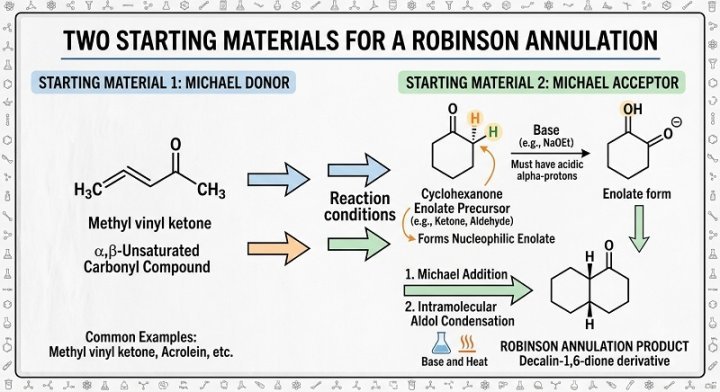
The Short Answer
A Robinson annulation requires exactly two starting materials:
- A ketone with an acidic alpha-hydrogen (often a cyclic ketone, such as cyclohexanone)
- Methyl vinyl ketone (MVK), or a related α,β-unsaturated ketone (an enone)
That’s it. Combine these two under basic (or sometimes acidic) conditions, and you get a bicyclic enone product through a beautifully choreographed two-step sequence.
Starting Material 1: The Ketone (The Nucleophile)
The first component is a simple ketone possessing at least one enolizable alpha-carbon. Cyclohexanone is the textbook example because it’s cheap, well-behaved, and produces a classic decalin-type product, but the reaction tolerates a wide range of ketones — including substituted cyclohexanones, cyclopentanones, and even acyclic ketones.
Under basic conditions (commonly sodium ethoxide, sodium hydroxide, or another alkoxide base), the base deprotonates the alpha-carbon of this ketone to generate an enolate. This enolate is the nucleophile that kicks off the whole sequence.
Starting Material 2: Methyl Vinyl Ketone (The Michael Acceptor)
The second component is methyl vinyl ketone, CH₂=CH-CO-CH₃, though chemists frequently substitute other α,β-unsaturated ketones (enones) depending on the target molecule. MVK is prized for its simplicity and reactivity — the vinyl group conjugated to the carbonyl makes it an excellent Michael acceptor.
One practical note for anyone running this reaction in a real lab: MVK is a lachrymator and needs to be handled with care, but its reactivity is exactly what makes the annulation so reliable.
How These Two Combine: A Quick Mechanistic Overview
The magic of the Robinson annulation lies in combining these two starting materials through two sequential reactions:
Step 1 — Michael Addition The enolate generated from the ketone attacks the beta-carbon of methyl vinyl ketone in a conjugate (1,4-) addition. This forms a new carbon-carbon bond and produces a 1,5-diketone intermediate — a single molecule now containing both original carbonyl groups, linked by a three-carbon chain.
Step 2 — Intramolecular Aldol Condensation That 1,5-diketone doesn’t stay put. Under the same basic conditions, an intramolecular aldol reaction occurs: a new enolate forms and attacks the other carbonyl within the same molecule, closing a six-membered ring. Dehydration (loss of water) then follows, generating a conjugated cyclohexenone system fused to the original ring.
The net result is a bicyclic (or polycyclic, depending on the starting ketone) enone — a scaffold that shows up again and again in natural product frameworks like steroids and terpenes.
Why Chemists Reach for This Reaction
The Robinson annulation earns its lasting popularity for a few reasons:
- Efficiency: two relatively simple building blocks combine to create a new ring system with a defined enone functional group in a single operational sequence (even though mechanistically it’s two steps).
- Versatility: by swapping out the ketone or the Michael acceptor, chemists can access a huge diversity of ring sizes, substitution patterns, and fused-ring architectures.
- Historical and pedagogical importance: it beautifully illustrates two fundamental named reactions — the Michael addition and the aldol condensation — working in tandem, making it a favorite teaching example for how reaction sequences build complexity.
A Note on Variations
Modern practitioners often don’t use MVK directly, since it can be difficult to handle and prone to polymerization. Instead, many labs use masked or protected equivalents (such as Stork enamine variants, silyl-protected vinyl ketones, or other MVK surrogates) that release the reactive enone in situ. The underlying logic, however, remains the same: one partner provides the nucleophilic enolate, and the other provides the electrophilic Michael acceptor.
Final Thoughts
At its core, the Robinson annulation is a story about two starting materials — a ketone and methyl vinyl ketone (or an equivalent enone) — combining through Michael addition and aldol condensation to build a new six-membered ring bearing a valuable enone handle for further functionalization. Understanding this reaction isn’t just useful for exams; it’s foundational for anyone heading toward total synthesis, medicinal chemistry, or natural product research, where ring-forming strategies like this one remain indispensable tools of the trade.
